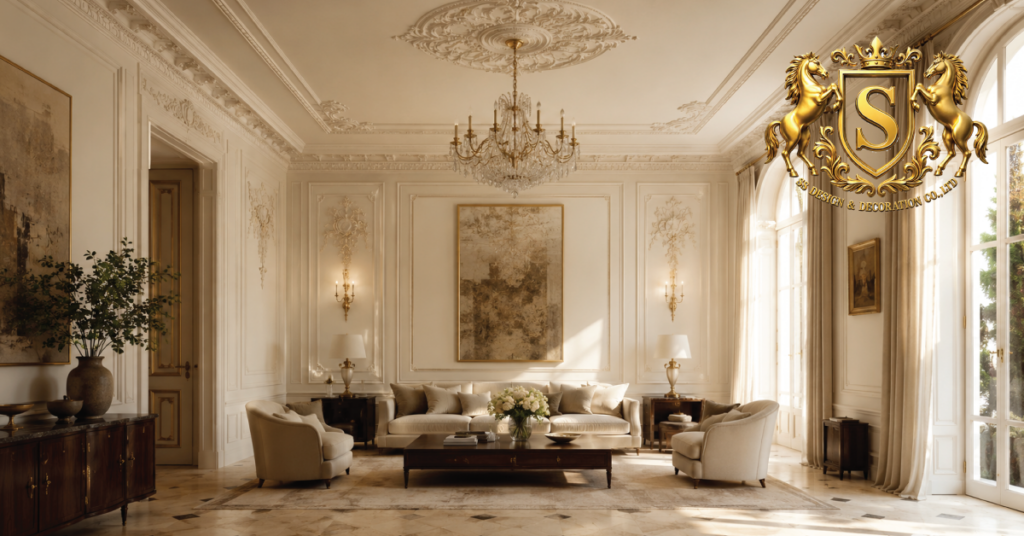
When it comes to luxurious interior decoration featuring graceful curves, floral motifs, ornate details, and decorative wall frames that add depth and character, many people in Thailand commonly refer to this style as “Louis-style moulding” or “Bua Louis.”
The term is widely used in the interior design industry, among contractors, and by decorative moulding suppliers. However, in reality, “Louis-style moulding” does not refer to one single, clearly defined architectural style.
In the Thai context, the term is better understood as a practical and commercial name used to describe decorative mouldings and ornamental details influenced by European classical design, particularly styles associated with Classic, Baroque, Rococo, and Neoclassical architecture.
The Origin of the Name “Louis”
The name “Louis” is closely associated with the French royal court during the reigns of several kings named Louis, particularly during the 17th and 18th centuries, when French art, architecture, and interior decoration had a major influence across Europe.
Palaces, reception halls, and aristocratic residences from this period were often richly decorated with elements such as:
- Ceiling cornices
- Decorative wall mouldings
- Ornamental plasterwork
- Floral and foliage motifs
- Scroll patterns
- Shell motifs
- Decorative mirror frames
- Center roses
- Pilasters and decorative capitals
These features later became strongly associated with the visual language of European luxury and what many people broadly describe as “Louis Style.”
As these decorative ideas were introduced into residential interiors in Thailand, the term “Bua Louis” gradually became a familiar and convenient way to describe classical mouldings with an elegant European character.
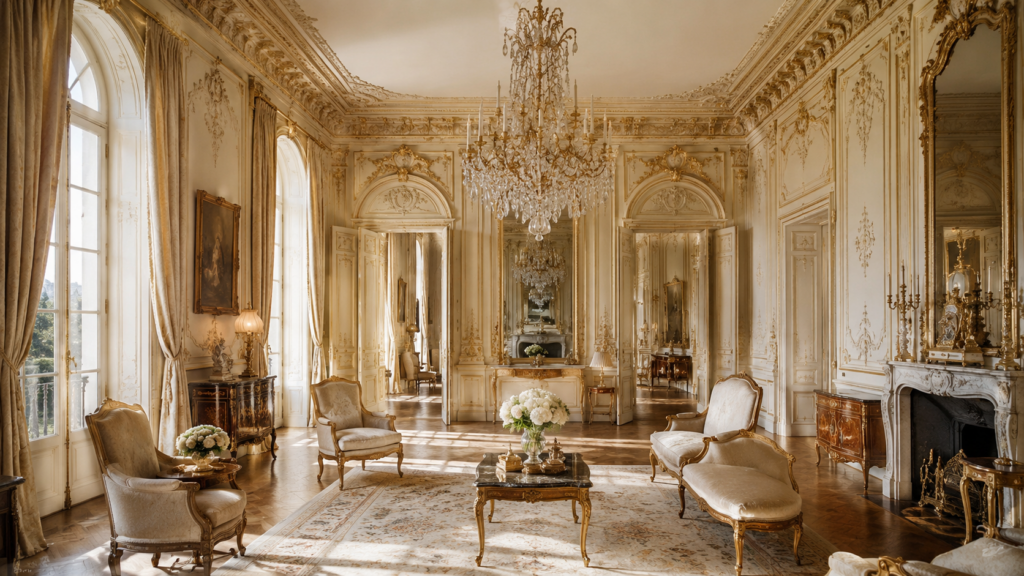
Louis-Style Moulding Is Not a Single Style
One important point to understand is that mouldings commonly called “Louis-style” today can vary greatly in appearance.
Some are highly ornate and dramatic, while others may consist only of slim, simple wall frames.
This is because these decorative forms are influenced by several different historical periods, each with its own distinctive character.
Baroque: Powerful and Dramatic Moulding
Baroque design emphasizes grandeur, movement, and visual drama.
Its decorative elements often feature deep relief, layered profiles, and complex curves.
Common elements include:
- Large cornices
- Floral and foliage ornament
- Decorative pilasters
- Scroll motifs
- Layered ceiling borders
- Large center roses
This style works especially well in grand halls, high-ceiling residences, luxury hotels, or spaces designed to make a strong visual statement.
However, when used in smaller rooms without careful control of proportion, Baroque detailing can make the interior feel overly heavy or crowded.
Rococo: A Softer and More Graceful Luxury
Rococo developed from Baroque but reduced its heaviness and formality.
Its defining characteristics include flowing curves, shell motifs, flowers, leaves, and naturalistic ornamental forms.
As a result, Rococo moulding tends to feel more romantic, delicate, and graceful than Baroque.
Typical elements include:
- Curved wall frames
- Floral ornament
- Foliage motifs
- Delicately detailed cornices
- Intricate center roses
- Decorative door or mirror surrounds
When combined with white, cream, pastel tones, or restrained gold accents, Rococo-inspired detailing can create a luxurious atmosphere without feeling too formal.

Neoclassical: Elegant, Clean, and Symmetrical
If Baroque and Rococo express luxury through abundant ornament, Neoclassical design expresses luxury through proportion.
Mouldings in this style tend to use straighter lines, stronger symmetry, and more restrained detailing.
Common examples include:
- Rectangular wall panel mouldings
- Clean-lined cornices
- Slim wall trims
- Simplified center roses
- Clearly defined pilasters
- Carefully proportioned wall divisions
This approach works particularly well in contemporary homes and has become an important foundation of Modern Classic interior design.
Is Modern Classic Considered Louis-Style Moulding?
From a strict stylistic perspective, Modern Classic is not directly the same as historical “Louis Style.”
However, in Thailand, many people still use the term “Bua Louis” to describe Modern Classic wall mouldings, ceiling cornices, and decorative trims.
This is because Modern Classic interiors continue to use a design language derived from classical architecture, including symmetry, proportioned wall divisions, and cornices that visually frame a room.
Modern Classic simply reduces and simplifies these classical elements so they suit contemporary homes and lifestyles more naturally.
What Types of Louis-Style Moulding Are Commonly Used?
When classified by placement and function, decorative mouldings can generally be divided into several groups.
- Cornice : A cornice is installed at the junction between the wall and ceiling. It helps conceal transitions, gives the upper edge of the room a finished appearance, and creates a visual frame around the space. Cornices range from simple, clean profiles to highly detailed ornamental designs.
- Cornice Corner :Cornice corner pieces are decorative elements used where cornice profiles meet at corners. In addition to creating a cleaner transition, they can also maintain the continuity of an ornamental pattern around the room.
- Center Rose :A center rose is a decorative feature placed at the center of a ceiling, often used together with a chandelier or pendant light. It helps establish a focal point and visually integrates the lighting fixture into the architecture of the room.
- Beading และ Wall Moulding :These are slim decorative profiles used to create frames and divisions on wall surfaces. They are especially popular in Modern Classic interiors because they add depth and architectural interest without making the room feel too heavy.
- Dome : A dome is a ceiling feature that introduces depth, dimension, and a stronger architectural presence. It is often suitable for entrance halls, living rooms, or spaces with high ceilings.
- Rim และ Decorative Accessories :These elements are used to complete details or add ornament to specific areas, such as corners, door surrounds, wall niches, or focal points.
More Moulding Does Not Always Mean More Luxury
One of the most common misconceptions in classical interior decoration is the belief that the more moulding and ornament a room has, the more luxurious it will look.
In reality, the opposite can easily happen.
If the mouldings are too large for the ceiling height, or if wall panels are divided too frequently, the room can feel narrow, heavy, and visually cluttered.
Good moulding design should therefore not begin with choosing the most decorative pattern.
It should begin by considering:
- Ceiling height
- Wall width
- Room size
- Door and window positions
- Furniture style
- Lighting and fixture placement
- The atmosphere you want to create
Once these proportions are understood, selecting the right moulding becomes much easier, and the room can feel elegant without relying on excessive decoration.
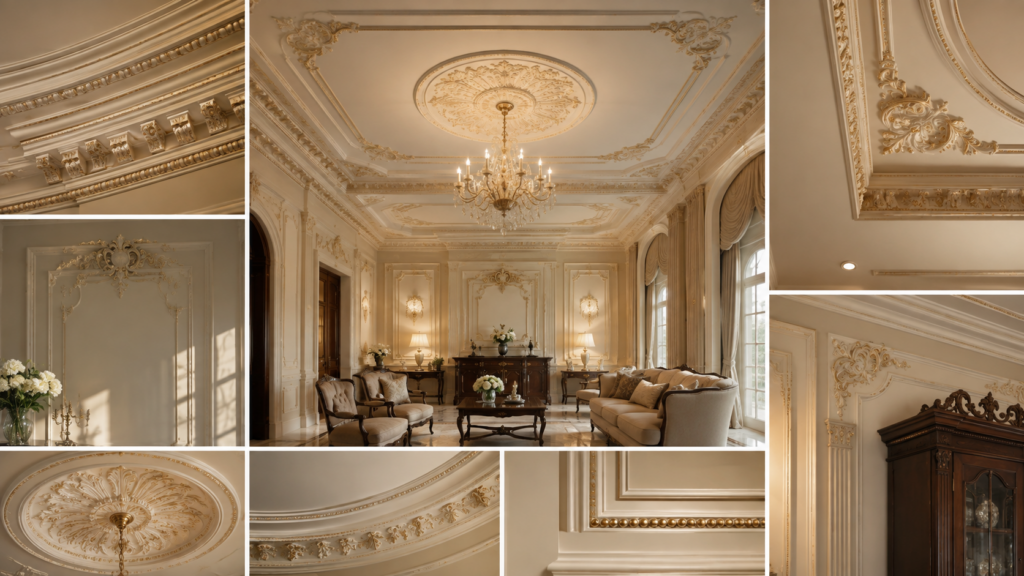
The Same Colour Can Create a Completely Different Effect
One popular technique in contemporary interiors is to paint the mouldings the same colour as the wall. Instead of highlighting the moulding with gold or a contrasting colour, a monochromatic finish allows the detailing to appear naturally through light and shadow.
The result feels softer and more contemporary. For example, cream walls with matching cream mouldings can create a warm and elegant atmosphere. Dark grey or black walls combined with mouldings in the same tone can create a sophisticated Luxury Modern look.
Gold can then be used selectively on certain details to add richness without overwhelming the space.
Choose Moulding to Suit the Home, Not the Other Way Around
The most beautiful moulding is not necessarily the one with the most detail or the one currently in trend.What matters most is whether it suits the actual space.
- A home with high ceilings may be able to accommodate larger and more detailed cornices.
- A condominium or a home with lower ceilings may benefit more from slim trims and simple wall panels that preserve a sense of openness.
- Large rooms can support more wall divisions, while smaller rooms may look more elegant with only a few larger panel frames.
This is why moulding should not be viewed simply as a decorative item added at the end of a project.
It should be considered as part of the overall spatial design from the beginning.
From Louis-Style Moulding to a Timeless Design Language
Although the term “Louis-style moulding” comes from the visual association with European classical art and luxury, the reason this type of decoration remains popular today goes beyond its historical appearance.
Its real strength lies in its ability to create proportion, depth, and identity within a space.
From the elaborate ornament of Baroque and Rococo to the calm symmetry of Neoclassical design and the refined simplicity of Modern Classic interiors, decorative moulding has continuously evolved with changing styles and lifestyles.
At SS Design & Decoration, we see moulding not simply as decorative trim, but as an architectural element that should work together with the entire space.
Because true luxury does not come from the number of details.
It comes from using the right details, in the right proportion, and placing every element exactly where it belongs.